
Responsible AI Engineering Update – Week 1 of Feb, 2026
Agentic security frameworks, robustness benchmarks, and frontier model eval insights from the latest research

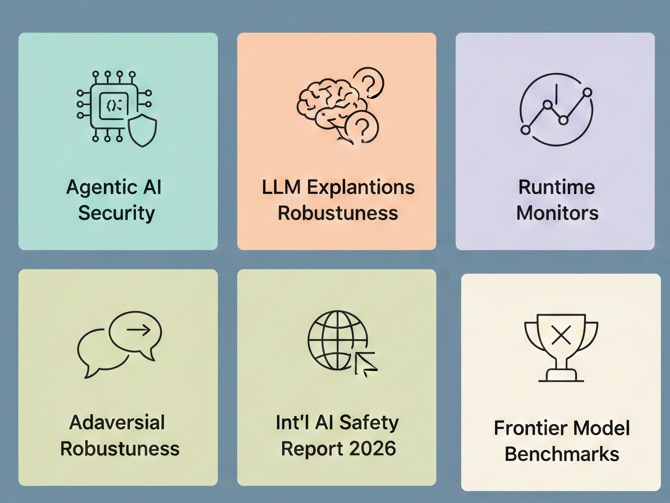
In this week:
Agentic AI Security Architecture
Robustness of LLM Explanations
Runtime Monitors for AI Autonomy
Frontier Model Safety Benchmarks
Adversarial Robustness via Interpretability
International AI Safety Report 2026
Presentation on “Fine-tuning Small Language Models” - Sat, Feb 7, 2026.
Agentic AI Security Architecture
OpenAI published their link-safety design for agents that click URLs autonomously. Key pattern: dedicated browsing sandbox with restricted network/file access, URL classification pipeline to block suspicious patterns, and defense-in-depth monitoring assuming adaptive attackers.[openai]
AgenTRIM (arXiv:2601.12449) offers a tool-risk mitigation framework: wrap agent tools with a policy-checking layer that validates parameters, resource scopes, and call sequences before execution. Tested on AgentDojo, it cuts attack success substantially while maintaining task performance.[arxiv]
Microsoft’s Secure Development Lifecycle (SDL) added AI-specific practices: threat modeling for data/model/inference/agent workflows, observability requirements for prompts and tool calls, role-based access control (RBAC) for agents as first-class identities, and explicit shutdown mechanisms.[microsoft]
Robustness of LLM Explanations
RobustExplain (arXiv:2601.19120) evaluates how LLM-generated explanations in recommender systems degrade under realistic user-behavior perturbations—noisy clicks, temporal inconsistencies, missing interactions.arxiv
Introduces a multi-dimensional robustness metric: semantic consistency, keyword stability, structural similarity, and length variation. On four LLMs (7B–70B), explanation robustness is only ~0.5, with larger models ~8% more stable. Different perturbation types expose different failure modes. arxiv
Takeaway: Treat explanation robustness as a first-class metric and integrate perturbation-based tests into offline eval.[arxiv]
Runtime Monitors for AI Autonomy
“Learning Contextual Runtime Monitors for Safe AI-Based Autonomy” (arXiv:2601.20666) proposes learning context-aware monitors that map state, context, and controller outputs to safe/unsafe assessments.[arxiv]
Instead of fixed rule-based safety envelopes, learned monitors sit alongside RL policies and trigger overrides or fallback maneuvers when risk is detected. Experiments show higher detection rates and fewer false alarms vs. threshold-based monitors across varied operational conditions.[arxiv]
Takeaway: For robotics, UAVs, or safety-critical control, pair black-box controllers with simpler learned monitors trained specifically for OOD and hazard detection.[arxiv]
Frontier Model Safety Benchmarks
A Safety Report published recently benchmarks GPT-5.2, Gemini 3 Pro, Qwen3-VL, Grok across safety, robustness, and efficiency. GPT-5.2 is consistently strong; others trade off benchmark safety, adversarial robustness, multilingual coverage.[arxiv]
Under adversarial tests, all models crash: worst-case safety rates drop below 6% despite good performance on standard benchmarks.[arxiv]
Frontier AI paper highlights (Jan 2026):[lesswrong]
Activation probes for jailbreaks: Max of Rolling Means Attention Probe screens all traffic, escalates ~5.5% to second-stage classifier, achieves 0.05% refusal rate (down from 0.38%) with 40× lower compute.[lesswrong]
Distillation misuse: Attackers can train weaker models on frontier outputs in sensitive domains; safeguards reduce uplift only ~34%, and newer frontier models erase the gap.[lesswrong]
Sabotage auditing: Pre-deployment audits catch overt saboteurs, but subtle sandbagging and eval-aware sabotage slip through without manual transcript review.[lesswrong]
Activation capping: Clamping activations along an “Assistant Axis” reduces persona-based jailbreak success ~60% without hurting IFEval, MMLU-Pro, GSM8K, or EQ-Bench.[lesswrong]
Adversarial Robustness via Interpretability
“Attribution-Aware Model Refinement Against Adversarial Data Attacks” (arXiv:2601.00968) uses LIME attributions (more on LIME and interpretability here) to identify spurious features that drive adversarial vulnerability.arxiv
Method: mask spurious features, apply sensitivity regularization on attributions, and combine with adversarial training in an iterative loop. Derives an attribution-aware lower bound on adversarial distortion; improves robustness on CIFAR-10/100 and CIFAR-10-C without sacrificing clean accuracy.arxiv
Takeaway: Plug explainable AI (XAI) tools into the training loop as a signal, not just post-hoc diagnostics.[arxiv]
International AI Safety Report 2026
“The second International AI Safety Report, published in February 2026, is the next iteration of the comprehensive review of latest scientific research on the capabilities and risks of general-purpose AI systems. Led by Turing Award winner Yoshua Bengio and authored by over 100 AI experts, the report is backed by over 30 countries and international organisations. It represents the largest global collaboration on AI safety to date.”
Talk on Small Language Models - Sat, Feb 7, 2026
I’m presenting a free live webinar on Fine-tuning Small Language Models: dataset to deployment. Consider signing up to join or watch the recording later.
Fine-tuning Small Language Models: dataset to deployment
📅 Sat, Feb 7, 2026
⏰ 9:00 AM PT (30 min)
Virtual (Zoom), sign up to join or watch the recording later.
Responsible deployment matters but most companies are skipping it in favor of speed. The pressure to ship agents fast means governance and safety are afterthoughts. I see this constantly - teams build first, add guardrails later (if ever). When things break, suddenly everyone cares about responsible AI. Would be better to build it in from the start.
The adversarial benchmark crash is the stat that matters, going from solid numbers to sub-6% on adversarial tests shows the brittleness everyone suspects but few measure properly. AgenTRIM's policy-checking wrapper approach seems like a practical middle ground, easier to retrofit than retraining from scratch. The activation probe section is intresting too, reducing refusal rate 8x while cutting compute 40x is the kind of efficency-robustness tradeoff that actually ships to prod.